
Top 10 Soft Skills Every Indian Professional Needs for Career Success
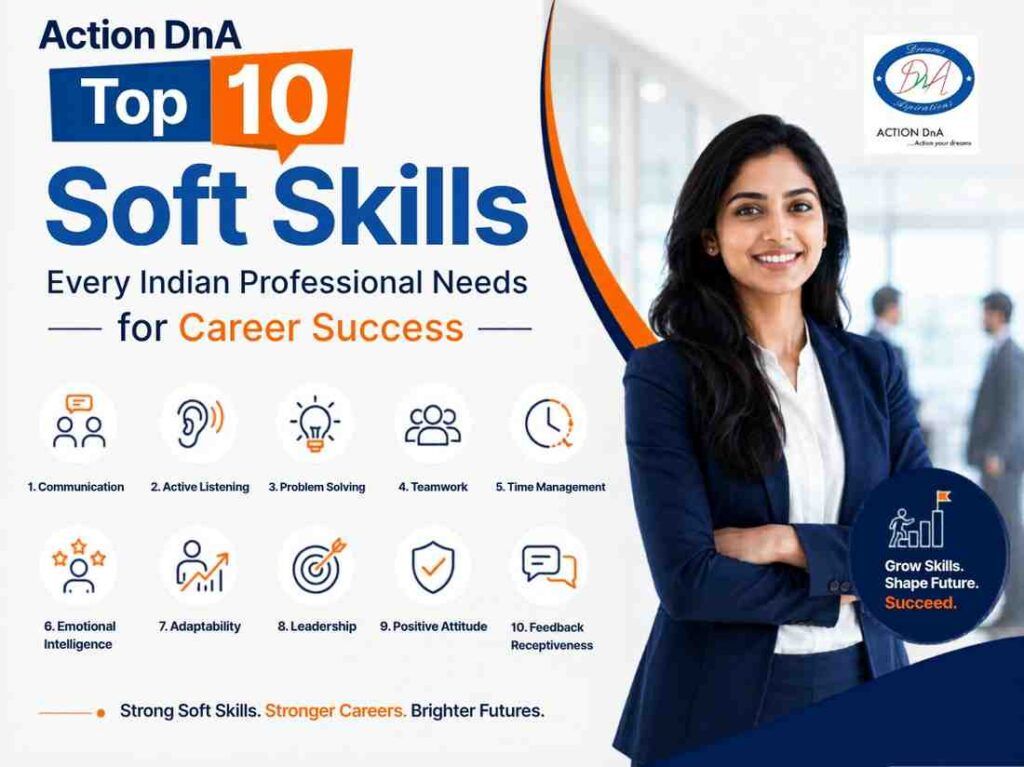
In today’s fast-moving world, having a degree or technical knowledge alone won’t take you far. The real game-changers are soft skills for Indian professionals — the invisible toolkit that separates good employees from great leaders.
Whether you’re a fresh graduate stepping into your first job, an IT professional eyeing a promotion, or a mid-level manager aiming for the C-suite, these career growth skills, workplace skills, and employability skills are what employers in India are truly looking for. From communication skills to emotional intelligence, from leadership skills to problem-solving skills — mastering these abilities is no longer optional.
It’s essential. In this blog, we’ll walk you through the top 10 soft skills that will genuinely transform your career trajectory in India’s competitive professional landscape.
Why Soft Skills Matter More Than Ever in India
India’s job market has evolved dramatically. According to multiple industry surveys, over 60% of hiring managers in India say they reject candidates not because of poor technical skills — but because of weak interpersonal and communication abilities.
The digital revolution, remote work culture, and global collaborations have made professional development a continuous journey. Companies like Infosys, TCS, Wipro, and hundreds of startups are now investing heavily in soft skills training because they understand one truth — technology can be taught, but character is built.
So, why are soft skills important in the workplace? Because they define how you work with others, how you handle pressure, and how you grow beyond your job description.
Top 10 Soft Skills Every Indian Professional Must Develop
1. Communication Skills — The Foundation of Everything
If there’s one skill that can fast-track your career overnight, it’s clear and confident communication.
In Indian workplaces, professionals often struggle with articulating ideas clearly in meetings, writing crisp emails, or presenting confidently in front of clients. Good communication isn’t just about speaking English fluently — it’s about being clear, concise, and confident in any language.
How to improve it:
- Join public speaking groups like Toastmasters
- Practice daily journaling or write short summaries of your work
- Watch TED Talks and observe how great communicators structure their thoughts
Strong communication builds trust with your team, impresses your boss, and makes you a go-to person in any organisation.
2. Emotional Intelligence — The Secret Weapon of High Performers
Emotional intelligence (EI) is the ability to understand and manage your emotions — and those of the people around you.
In high-pressure Indian corporate environments, professionals who can stay calm during conflicts, empathise with their colleagues, and handle criticism without ego tend to rise faster than those who can’t.
EI has four core components: self-awareness, self-regulation, empathy, and social skills. Developing these doesn’t just improve your relationships at work — it directly impacts your leadership potential.
Quick tip: Next time you feel frustrated at work, pause before reacting. That three-second pause is the beginning of emotional intelligence.
3. Leadership Skills — You Don’t Need a Title to Lead
Many Indian professionals wait for a promotion before they start “acting like a leader.” That’s the wrong approach.
Leadership is about taking ownership, inspiring others, and making decisions even when the path isn’t clear. Whether you’re managing a team of two or twenty, showing initiative, guiding peers, and taking responsibility for results is what gets you noticed.
Soft skills examples of leadership in action:
- Volunteering for challenging projects
- Mentoring junior colleagues
- Speaking up with solutions, not just problems
The best leaders in India’s corporate world didn’t wait to lead — they led first, and the titles followed.
4. Teamwork Skills — Because No One Succeeds Alone
India has a deeply collaborative culture, yet workplace teamwork often breaks down due to ego, miscommunication, or unclear roles.
Strong teamwork skills mean knowing when to speak, when to listen, when to push forward, and when to support others. As organizations increasingly rely on cross-functional teams, the ability to work seamlessly with colleagues from diverse backgrounds has become a defining professional strength.
Employers specifically look for professionals who can check their ego at the door and prioritise collective success over personal glory.
5. Problem-Solving Skills — Think Beyond the Job Description
Every organisation, regardless of size, faces challenges daily. Professionals who can think on their feet, analyse situations, and offer practical solutions are invaluable.
In India’s VUCA business landscape—marked by volatility, uncertainty, complexity, and ambiguity—strong problem-solving abilities are highly valued by employers. This doesn’t mean you need to have all the answers — it means you approach challenges with curiosity and structure rather than panic.
Try this framework: When faced with a problem, ask — What do I know? What don’t I know? What are my options? What’s the best next step?
6. Adaptability Skills — Thrive Through Change
Post-pandemic India has rewritten the rulebook. Remote work, hybrid models, AI tools, frequent restructuring — change is the new normal.
Professionals who embrace change rather than resist it are the ones who stay relevant and continue growing. Adaptability doesn’t mean agreeing with everything — it means staying flexible, updating your skills, and maintaining a positive attitude even when plans fall apart.
Soft skills for freshers especially: The ability to adapt to a new workplace culture, different working styles, and evolving job roles is something companies absolutely love in young talent.
7. Time Management Skills — Your Most Underrated Asset
Here’s a hard truth — most Indian professionals are busy, but not productive.
Working late doesn’t mean working well. Time management is about prioritising the right tasks, setting realistic deadlines, saying no when necessary, and protecting your focus.
Tools like time-blocking, the Pomodoro technique, and simple to-do lists can transform how you work. Professionals who manage their time well reduce stress, deliver better results, and earn the trust of their managers.
Remember: Every person — your CEO included — has exactly 24 hours. How you use yours defines your career.
8. Critical Thinking Skills — Question, Analyse, Decide
In an age of information overload, the ability to separate facts from noise, question assumptions, and make logical decisions is increasingly rare — and incredibly valuable.
Critical thinking skills help you evaluate data before acting on it, challenge processes that no longer serve the business, and bring smarter solutions to the table. This skill is especially crucial for MBA students, analysts, consultants, and anyone in a decision-making role.
The good news? Critical thinking can be practised. Start by questioning “why” more often — why does this process exist, why did this outcome happen, and what would happen if we did it differently?
9. Interpersonal Skills — Build Relationships That Build Careers
Careers are rarely built on talent alone. They’re built on relationships.
Interpersonal skills include how you treat people, how you network, how you handle disagreements professionally, and how you show up for your colleagues. In India, where workplace hierarchies are strong, the ability to connect respectfully across levels — from interns to CEOs — is a rare and powerful skill.
Strong interpersonal skills also make you a culture-builder — someone others genuinely want to work with. And that reputation? It’s career gold.
10. Professional Development Mindset — Never Stop Growing
The professionals who reach the top in India are not the smartest people in the room. They’re the ones who never stopped learning.
A professional development mindset means actively seeking feedback, attending workshops, reading widely, and investing in your own growth. Whether it’s enrolling in a soft skills training programme, listening to industry podcasts, or working with a mentor, continuous learning keeps you ahead of the curve.
At ACTION DnA, we believe that every professional has unlimited potential — and it’s activated through consistent, intentional development.
How to Improve Soft Skills for Career Growth — A Quick Roadmap
Knowing the skills is one thing. Building them is another. Here’s a simple roadmap:
Step 1 — Self-Assessment: Identify your top two or three weak areas honestly.
Step 2 — Seek Feedback: Ask a trusted colleague or manager where you can improve.
Step 3 — Practice Daily: Soft skills grow through repetition, not just reading about them.
Step 4 — Enrol in Training: Structured programmes accelerate growth significantly.
Step 5 — Measure Progress: Review your growth every 30, 60, and 90 days.
The best time to start was yesterday. The second best time is right now.
Final Thoughts — Your Career Deserves More Than Technical Skills
Whether you’re a college student preparing for your first interview, a seasoned IT professional chasing a leadership role, or a mid-level manager ready for the next level — soft skills are your competitive edge in India’s evolving job market.
The companies that are hiring and promoting today aren’t just looking at your resume. They’re watching how you communicate, how you collaborate, how you handle pressure, and how you grow. These ten skills are not just nice-to-haves — they are the real currency of workplace success.
At ACTION DnA, our mission is simple: to help Indian professionals unlock their full potential through transformational people development programmes. Because when people grow, organisations grow — and that’s how India grows.
What are the most important soft skills for Indian professionals?
The most important soft skills for Indian professionals include communication skills, emotional intelligence, leadership skills, teamwork, adaptability, problem-solving, time management, critical thinking, interpersonal skills, and a continuous professional development mindset. These skills are no longer “good to have” — in today’s competitive Indian job market, employers across IT, corporate, and startup sectors actively look for these qualities before hiring or promoting professionals. Mastering these skills helps you stand out, earn trust, and grow faster in your career.
Why are soft skills important for career growth in India?
Soft skills are important for career growth in India because technical knowledge alone is no longer enough to succeed in modern workplaces. Companies like TCS, Infosys, Wipro, and leading MNCs have clearly stated that poor soft skills are one of the top reasons candidates get rejected — even when they are technically strong. Soft skills define how you communicate with your team, handle workplace pressure, resolve conflicts, and lead people effectively. Professionals who invest in building these skills get promoted faster, build stronger networks, and achieve long-term workplace success that technical skills alone cannot guarantee.
How can freshers and working professionals improve their soft skills?
Freshers and working professionals can improve their soft skills by following a few simple but powerful steps. Start with an honest self-assessment to identify your weak areas — whether it’s communication, time management, or emotional intelligence. Actively seek feedback from mentors, colleagues, or managers. Practice skills daily through real workplace interactions rather than just reading about them. Enrol in structured soft skills training programmes like those offered by ACTION DnA, which are specifically designed for Indian professionals at every career stage. Consistency is key — small, daily improvements compound into massive career growth over time.
What soft skills do employers look for most in India??
Employers in India most commonly look for communication skills, leadership potential, teamwork ability, problem-solving mindset, and adaptability when evaluating candidates for both hiring and promotions. In sectors like IT, BFSI, consulting, and manufacturing, emotional intelligence and critical thinking are also highly valued. HR professionals and talent managers across India consistently report that candidates who demonstrate strong interpersonal skills and a growth mindset are preferred over those with only technical qualifications. Investing in these employability skills not only helps you land better opportunities but also positions you as a high-value professional in any organisation.